When I’d visited my mother two weeks before, I found her sitting in a chair in the dining room of her memory care home out in the Amish country of Hiram Ohio. She really looked quite beautiful, but she had always been beautiful to me. Her hair had been done, her blue eyes were large and shining, her face luminous, but she couldn’t speak or even move much. I sat down next to her and began to cry. During the last years of her dementia, whenever I cried or became upset, she just stared at me, curious as a child. Guileless. Her expression suggested, “Why are you crying? Whatever for?” I like to think that she knew, but she may not have known which of her three daughters I was.
Through my tears I said, “Mom, I hope you don’t have to do this much longer.”
With great effort she lifted her right hand and tried to cross her index and middle finger. She’d understood what I’d said. Then she brought those fingers to her mouth and touched her tongue. I realized she wanted some water so I got her a drink and brought it to her lips. She took a sip and seemed to try to speak but couldn’t. I imagine she would have told me not to worry, that she was okay. That she was ready.
Two weeks later, my younger brother David called to say he’d given the go ahead, as agreed by my family previously, to allow the start of hospice care for Mom. I understood that hospice care could last anywhere from a matter of days to months and years, but within a few days they’d begun to administer morphine at intervals, which was a sign she was dying. I had planned to drive back to Cleveland to see her anyway, but now things moved faster than any of us expected.
I arrived midafternoon on a hot Sunday in late August, the sky clear and blue, the sun burning my arms through the windows of my car as I drove. I found my older sister Mary had been with Mom since the previous day and Saturday night, and had tried to get a little sleep in an uncomfortable chair in her room.
Now Mom’s appearance shocked me. She lay on her back, her head tilted so that her neck appeared to be strained. From the luminous, glowing beauty and fading fire in her blue eyes of two weeks previously, her skin had taken on a grayish-yellow hue and sunk away so that the skeletal outlines of her cheekbones and nose were very pronounced.. The words “in extremis” came to my mind. I didn’t want to see her like this.
I sat next to her bed and took her hand. She responded by moving her feet a bit, and although one can never be sure, I think she knew I was there. Memories of being a small child, following her around outside as she gardened on a spring morning before storm clouds darkened the sky, the scent of rain in the air, came to my mind, too. How that had once been enough for me, to be with her! But she eluded me. She had her hands full and I could never quite have her all to myself with seven brothers and sisters. I told her this, that I had always wanted more of her than she possessed to go around. That I was sorry I had been such a pain in the ass and given her so much trouble. I told her that she was a good mother and the strongest woman I’d ever known, that she’d worked hard taking care of everyone else her whole life and now she could rest. That I loved her. I read my favorite Psalm 23, “The Lord is my shepherd; I shall not want.”
Mary showed me how to administer doses of morphine to Mom every four hours since she had to leave and finally get some sleep. Before she left, a priest arrived and administered last rites, and if I remember correctly we took the offered Communion wafer.
Most of my siblings and their children (16 total grandchildren) had seen Mom more than me over the years and done more to take care of her (and my father when he was alive) because they all lived closer, while my younger sister and I lived out of town. Now my brothers, their wives, and their children came to spend their last moments with her, sitting next to the bed and talking to her. They held the phone up to her ear so she could hear goodbyes from her remaining brother and sister and other relatives who lived far away. I was surprised and pleased when my oldest son Max texted me to say he’d be arriving shortly, also driving north from Cincinnati. I was so happy to see him. He asked for some time alone to sit with his grandmother. As I left the room I heard him say, “I was your first grandchild.”
During that long afternoon, as so many members of my large family visited Mom, I noticed a woman resident greeting them. She seemed to revert to a time in her life when she was the reigning matriarch in her own family, perhaps opening the door to children and grandchildren as they came to spend the holidays. She exclaimed each time an attendant buzzed one of us in through a locked entrance door, marvelling at our numbers, and said things like, “Oh my, what is all this? What am I going to do with all of you?” She no longer needed to make food or other preparations, and seemed at a loss, but bustled around with nervous energy. What to do when one can’t busy oneself anymore with making the food and coffee, because one can’t remember or follow a recipe let alone turn on a coffee pot? Over the course of about six years I’d seen my mother go from accomplishing ten or fifteen difficult tasks each day to being unable to read or write, drive, follow a recipe, recognize people, walk, and finally, talk.
While my son stayed with his grandmother, I went and sat on the screen porch with the rest of my family. Outside the blast furnace sun of late August conspired to incinerate an ocean of yellow green grass dotted with black-eyed Susan, purple coneflowers and orange butterflyweed. We could hear a herd of cows lowing in the distance as they trudged the meadow of their pasture through dense humidity, home to their barn.
I agreed to stay the night with Mom. One of my brothers would replace me in the morning. Eventually everyone left and I was alone with her. She had grown more still–we must have exhausted her very last ounce of strength, as usual. But she was always happiest with everyone around.
It was after 6 pm–I must have eaten something my sister-in-laws brought, but I can’t remember. I sensed a cooling of the atmosphere outside even while inside in the air conditioning– that, and the slow blooming of grayish blue thunderclouds in the distance confirmed by a glance out a window–the light had changed not only because the sun had begun to set. I continued to slip a dropper full of morphine into Mom’s mouth every four hours. I sat in the uncomfortable chair and tried to read but couldn’t concentrate, glancing at her from time to time to see if she looked comfortable. Darkness came. I couldn’t see the progress of the storm anymore, but could feel the growing tension in the atmosphere, quite literally like a balloon about to burst, but the tension continued to surge against whatever restraint was held by burgeoning clouds.
At about 11 o’clock one of the aides, a young brunette woman, suggested I go across the hall and lie down in a bed in a vacant room. I said I might take her up on that but didn’t want to miss Mom’s next dose of medicine even though the aide would have gladly done it. Then I wondered if the aide was trying to tell me something.
“Do you think it would be better for Mom if I left her alone for a little bit?” I asked. “I mean, in your experience, will it help her any if I leave, or will it help her if I stay?” What I meant, without saying so, was, “Will it help her die?” Or “pass,” as so many people say nowadays. Both propositions sounded quite awkward but the young woman understood.
“Either way is fine,” she said. Well, so much for that.
The wind began to kick up outside. I sat listening to the sound of the gusts against the window. Out in the hall a few doors down, the restive resident matriarch of the afternoon had to be ushered back to her bed a few times. I looked at Mom. Her head had turned to face the wall on her right, next to her bed, and her eyes were half open, staring at something I couldn’t see, but she was still breathing, less laboriously than before. I gave her another dropper of morphine just before midnight.
“Mom, I’m going to go across the hall for a few minutes. I’ll be right back.” I stood watching her a moment, then crossed the hall to the room the aide showed me. I lay down fully clothed in the uncomfortable bed. It was then the storm that had been building and threatening all evening finally let loose outside. Lightning lit the room with blinding white flashes. Thunder cracked directly over my head and registered in my throat and heart. I was afraid. Wind howled against the building, ressembling the most cliche movie sound effects for a storm at sea. It whistled. It wracked the little memory care unit building, which was connected only by a parking lot to a larger assisted living facility next door. After about fifteen minutes of atmospheric havoc, the wind died down, but I couldn’t sleep. I got up and went back into my mother’s room as the rain slackened from a deluge to a gentle drumming on the windows and roof.
She had stopped breathing. I checked the time–it was about 12:30 am. Monday morning. I bent to her mouth and felt the coolness already settling in to her lips and cheeks. I stared. I kissed her forehead. How had I missed her? Despite the knowledge of her death’s inevitability, despite my family having surrounded her all day with love and care in hopes of her passing easily from this world, I was still shocked at how she’d slipped away from me again. How long had she been gone? I didn’t know. Fifteen minutes?
I left the room to tell the aides that my mother had passed. Standing in the middle of the hall, the afternoon resident matriarch held herself with crossed arms, crying. I went outside, under an awning out of the rain. The relief in the cool air was palpable. A dam had burst. And Mom had gone out with the storm.
After making calls to the hospice people, family, and the funeral home, I left to stay with my brother Matt and his wife in Aurora. As I drove out of the parking lot, I noticed some emergency vehicles blocking my path. A tree had been blown down across the road, forcing me to take another route. I had to wonder. From my first memories, I saw my mother as a powerful woman. It seemed appropriate to me, and not out of the realm of possibility, that her leave-taking may have blown that tree over. But this wasn’t even the strangest thing that happened.
At my brother’s house, I went to the room they’d prepared. Their dog Buddy nudged open the door to my room. He climbed into bed with me for awhile and let me pet him. He seemed to know I needed comfort, but I didn’t sleep.
I rose early and went back to get Mom’s things. Although I could have cleaned out her room the night before, I just didn’t want to do that while her body was still there, waiting for the funeral home people to arrive. Now the room was empty but for the scant things she had kept in her closet and bathroom, the few family photos and mementos. Though these weren’t the sum total of her possessions, still I couldn’t help but remark to myself at how Mom’s life had been reduced to such a meager and limited existence; but she had all she wanted, needed, or could even use, all except for her once communicative, articulate, lucent mind and strong body. I loaded her things into my car and texted my family before I left. The tree still blocked the road so again I took an alternate route.
I drove down the road I’d taken the night before. The sun was still low and pink in the sky, a glowing background in stark contrast to the drenched black trees of the woods; the pavement slick and littered with small branches from the storm. A return text pinged on my cell phone so I looked down a moment, and when I looked up again I noticed something, an obstacle, ahead of me in the center of the road.
I was only going 35 mph, but slowed down and stopped a good ten feet from whatever it was that blocked me.
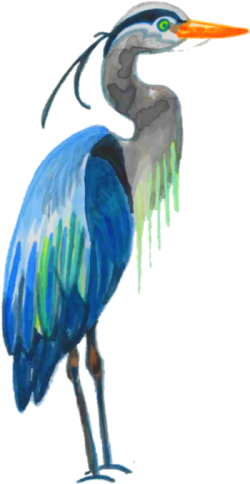
It was a blue heron (I didn’t know at the time, I had to look it up later) standing smack on the double line in the middle of the road, and it was staring directly at me. The tall bird didn’t ever avert its gaze but seemed to regard me with stern disapproval. More likely the heron, having binocular vision, saw my car and decided an automobile might be too large a fish to spear with its long yellow beak. But it was a regal bird! Standing fully erect, it could have been five feet tall. A pair of black plumes right above its eyes extended back along its whitish head. I suppose the heron couldn’t help that its eyes, set on each side of the head but forward looking, gave this unsmiling impression. But I knew that, in a sense, it was my mother. She may have been telling me to buck up, to avoid dwelling on mourning in future. I would like to think of her that way, as this heron, that suddenly lifted itself up into the air. I had to make a left turn, and another to get back on a main road, and as I made the second left I saw the blue heron, its massive wings flapping slowly, flying high above and over the road as I drove, on its way to the marsh.
I’ve always felt that truth is far stranger than any fiction. Stranger and more wonderful. The experience was almost unbelievable to me, but watching the heron lift itself up and fly majestically away–that’s how, in part, I want to remember my mother, liberated. Free. She’d done her job, which was to show me how to die when my time comes, and I’m no longer as afraid of my mortality.
We come into the world and take a breath, and that spirit leaves us for heaven or parts unknown when we exhale our last. We don’t disappear completely. I think we rise, somehow.


What a beautiful and well written memoir of your relationship between you and your mother’s final time spent together. The tears came as I read about the Blue Heron. Thank you for sharing. You are very talented. Keep writing!!!
LikeLike
Oh my God. This is potent. Beautiful and potent and I believe to be true!
LikeLike
Love you, Anne!
LikeLike
I’m so sorry for your loss. I think you’re right, we won’t disappear completely. We rise, somehow.
LikeLike