
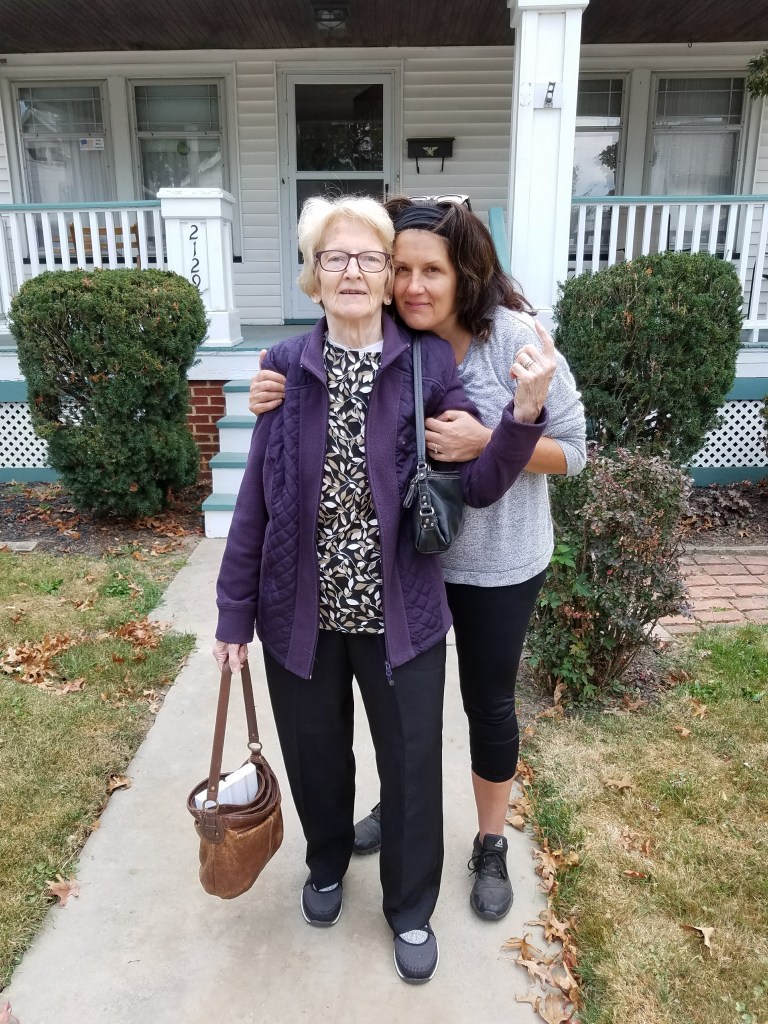
September 2017
Chapter 1
As I turned left from Bayes onto Brown Road in Lakewood, the familiar, repetitive, beep-beep-beeping of heavy construction equipment didn’t strike my ears as unusual. A few years earlier, when my father was still alive, the city had demolished Roosevelt Elementary School, a red brick rectangular structure just a block away from my home and where I attended kindergarten. The new building seemed to sprawl over the area of two city blocks. I had begun to visit my parents more often when my dad began dialysis and my mother was diagnosed with dementia in 2012-13. The droning engine and beeping sounds of bulldozers, forklifts and wheel loaders provided a background noise that filled the air all day long. Dust and dirt from the demolition of the old school building, and probably also exhaust from increased traffic, coated our white front porch siding. If the weather was reasonable and I had time, I’d wipe clean the horizontal vinyl strips. By the next time I visited, though, the gray sediment had returned.
Today I pulled up to the only home I ever knew as a child and then I remembered– the city had already completed construction of Roosevelt Elementary. I’d just driven past it. So now what was going on? I was about to park on the street in front of our house when I saw a blacktop roller and grader working at the corner of Brown and Athens just a few houses away. I glanced up and saw Mom standing on our front porch, waving at me to park in the driveway, so I did.
I parked my car in the driveway and got out. It was the last week of September 2017, warm but not humid, the skies clear and blue. Mom stood on the porch smiling and shaking her head.
“They finally decided to pave the street,” she yelled over the din, “right when I’m leaving.”
It was true. I’d come to stay with her for the week before she moved into an assisted living/memory care facility. This would be her final week in the house where I grew up, where she’d lived with eight children and my father for over 50 years.
“Yep, it figures,” I yelled back as I grabbed my bag from the car.
She waved her right arm toward the street. “How come it’s clean in front of everyone else’s house?” she asked.
“What do you mean?” I climbed the front porch steps and dropped my overnight bag down on the painted boards.
“There, there,” she said, agitated, motioning to the street again. “None of the other houses have that.”
I looked out to the road, a nearly spotless, smooth layer of macadam that reminded me moist cake.
“I don’t know what you mean,” I said. “Clean?”
“There, THERE!” she cried, pointing. I turned around to look again and noticed Mrs. Wilhelm, the lady who lived across the street for as long as I’d been alive, and my mother’s friend until they’d had a falling out, had come out on her porch and was watering her hanging begonias.
“Close to the….close to the…I don’t know what it’s called!” she nearly shouted, frustrated that she couldn’t find the word, before she saw Mrs. Wilhelm and lowered her voice.
I went back down the steps and walked over to our curb lawn. A whitish substance that looked to me a bit like dried cement or plaster–not just a spot but a sort of blob, marred the perfect surface of macadam.
“This?” I asked, pointing to the blob and trying not to sound irritated. It was going to be a long week, so I had better be patient.
“Yes!” She clapped her hands together, relieved to be understood.
“Oh, don’t worry, I’ll clean that off. It’s nothing,” I said.
“But no one else, no other house has that in front,” she insisted.
“Don’t worry, I’ll, here…” and, hoping to solve the matter quickly, kicked at the blob with the point of my right toe, then rubbed my shoe in the chalky matter. “I guess I’m going to need some water. I’ll get the hose,” I said. I’d just arrived home and she was putting me to work.
“We don’t have one anymore.”
“You don’t have a hose? Since when?”
She shrugged.
“Oh, well then how about a bucket?”
“If you can find one in there,” she gestured inside. “I don’t know where anything is anymore.”
“Yeah, I’ll fill a bucket with water and wash it off…”
Just then the grader which was near the corner turned and headed toward me where I stood in the street, mucking about in the white offal. I realized I looked rather foolish.
The driver, a big-headed man, crew cut, thick jaw, red but pleasant face and expression, looked at me and raised his eyebrows in a question.
“We’re not done here yet. There’s another layer goin’ on top of this one,” he said.
“Oh, I’m sorry. She–” I pointed to where I thought Mom still stood on the porch, but apparently she’d vanished. Then I saw the reflection of light off her eyeglasses as she stood a little behind the front door, listening.
I turned back to the driver. “She wanted me to clean if off,” I said sheepishly. I smiled at the man. I didn’t want to insult or embarrass my mother by saying something more like, “She has dementia and has odd ideas sometimes, or she doesn’t know what she’s talking about sometimes.” So I said nothing and instead tried to communicate with my eyes and eyebrows that I had thought it a bad idea as well, that is, clean the blob off the unfinished macadam, but what could I do?
Only the driver’s blue eyes moved in his red face when he looked from me up to the front door, then back to me. Then he nodded and wordlessly wheeled the grader around and bobbed away. I found myself shaking my head, already somewhat exhausted, and I hadn’t even set foot inside the house yet.
“What does she have you doing now?” I heard Mrs. Wilhelm call from her front porch. I turned around.
“Oh, I don’t know…”
She came slowly down her front steps, and because I had always liked if not loved Mrs. Wilhelm and knew it would be rude if I ignored her, I walked from the middle of the street to the sidewalk in front of her house and gave her a little hug. The woman always smelled as clean and fresh as cucumbers. With my back to our house, I knew Mom couldn’t really hear what we were saying, nor, I thought, would she be able to read my lips like Hal the computer in 2001, discover my “betrayal,” and banish me to hyperspace where my corpse might spend its days orbiting the moon.
I stood back. “She wanted me to hose off that pile of cement or whatever it is in front of the house.”
“Oh brother,” said Mrs. Wilhelm, nodding knowingly. “Don’t try to please her. You can’t.”
“I know,” I said. “I better get going.” I smiled and turned to cross the street. Mom had emerged again to stand on the porch.
“What were you talking about? What did she say?” she asked.
“I just told her you wanted me to clean that stuff off the street. But that man,” I pointed to the workers, “said that they weren’t done paving yet. They’re going to put another layer of blacktop down on the road before it’s finished, so it doesn’t make sense to clean it off.”
“Oh.”
“So no worries, it will be gone soon.”
“Okay.”
We went inside to start dinner.
 scaredy cat ink